A landing page is the fastest way to test an idea, collect leads for an ad campaign or launch sales of a single product. But “one page” does not mean “simple”. On a landing page every block works towards a single action, and any superfluous detail costs you conversion.
In this article we break down when landing page development genuinely makes sense, which blocks make up the landing page structure, what affects conversion, what to build it on and how much it costs.
What a landing page is and when you need one
A landing page is a one-page site with a single target action: submit an enquiry, book a consultation, buy, register. Everything else — navigation, catalogue, blog — is removed so as not to distract the visitor.
When a landing page is the right choice
- Traffic from advertising. Google Ads, Meta, paid social — the user arrives with a specific intent and must see the answer immediately.
- A single product or service. A course, consultation, tour, event, or course enrolment.
- Testing a hypothesis. Quickly find out whether there is demand before investing in a large site.
- An event or launch. A webinar, conference, pre-sale.
When a landing page will not do
If you have a dozen services, a product catalogue or a focus on organic search, a single page becomes a limitation. Search traffic needs separate pages for separate queries, and selling different products needs different scenarios. In that case, consider full-cycle website development.
Landing page or multi-page site
The difference is not in the number of pages but in the source of traffic. A landing page lives on advertising: you pay for the visit and must convert it here and now. A multi-page site lives on search, reputation and content — it accumulates traffic over months, but for free.
A working strategy for small business is to start with a landing page for paid traffic and, once the niche is confirmed, expand it into a full site with a blog and service pages. Technically this is straightforward if the landing page was built on a proper CMS in the first place, rather than in a closed builder.
Landing page structure that sells: the blocks to include
There is no universal template, but there is a proven logic: attention → interest → trust → handling objections → action. Below are the blocks that implement it.
1. The first screen
Within 3–5 seconds the visitor must understand what you offer, to whom, and what to do next. You need a clear benefit-led headline (not “Welcome”), a short subheading and one prominent button. The headline should echo the ad the user came from — otherwise they feel they landed in the wrong place.
2. Problem and solution
Show that you understand the client’s pain and explain exactly how your product removes it. This is the shortest path to trust: the person recognises their own situation.
3. Offer and benefits
Not features but outcomes. “Responsive markup” is a feature. “The site works just as well on a phone, where 70% of your clients come from” is a benefit. Format: 3–6 points, each with an icon and a single sentence.
4. Social proof
- Case studies with numbers — “enquiries grew from 12 to 47 per month”.
- Testimonials with a name and photo — an anonymous testimonial does not work.
- Client logos, certificates, media mentions.
5. Objections and FAQ
Write down 5–7 reasons why someone does not submit an enquiry (“too expensive”, “not sure it fits”, “what if I don’t like it”) and close each with a direct answer: a guarantee, a free consultation, instalments, an example of your work.
6. Call to action
The CTA repeats 3–4 times down the page — not everyone is ready to act after the first screen. The button should describe the action, not an abstraction: “Get a quote” instead of “Submit”.
What actually affects conversion
Load speed
Every extra second of waiting costs you a share of the visitors you have already paid the ad platform for. On a landing page this hurts more than anywhere else: there is no second chance. Compress images to WebP, remove heavy libraries, deliver critical CSS immediately. The target is a Largest Contentful Paint under 2.5 seconds on mobile 4G.
The mobile version
Most ads are opened on a smartphone. Check not merely “whether the layout broke” but whether the button is comfortable to tap with a thumb, whether the headline reads without zooming, and whether a sticky block covers the form.
The enquiry form
Every extra field reduces conversion. For first contact, a name and one contact channel are enough. You will find out the rest in conversation. Add a phone input mask, clear error messages and a thank-you screen — the user must see that the enquiry went through.
What to build a landing page on
Builders give a fast start but over time become a cage: limited speed, someone else’s domain on the plan, no fine-grained analytics control, and above all — you cannot take the page with you.
WordPress with a custom theme gives a different result: clean code without excess, full control over speed, free integration with CRM and analytics, and the ability to grow the landing page into a multi-page site at any time. You choose the hosting yourself; there is no vendor lock-in.
Analytics and the technical foundation
A landing page without analytics means spending without feedback. The minimum set before launching ads:
- Google Analytics 4 with an event on form submission.
- Google Tag Manager — to add pixels without code changes.
- Ad platform pixels for retargeting.
- Click and scroll maps (Clarity, Hotjar) — you can see where people stop.
- Enquiries into a CRM or Telegram, not just email — response speed affects the sale.
Plus basic technical hygiene: SSL, correct meta tags, Open Graph for a good preview in messengers, robots.txt, and a privacy policy page — without it ad platforms may reject your ads.
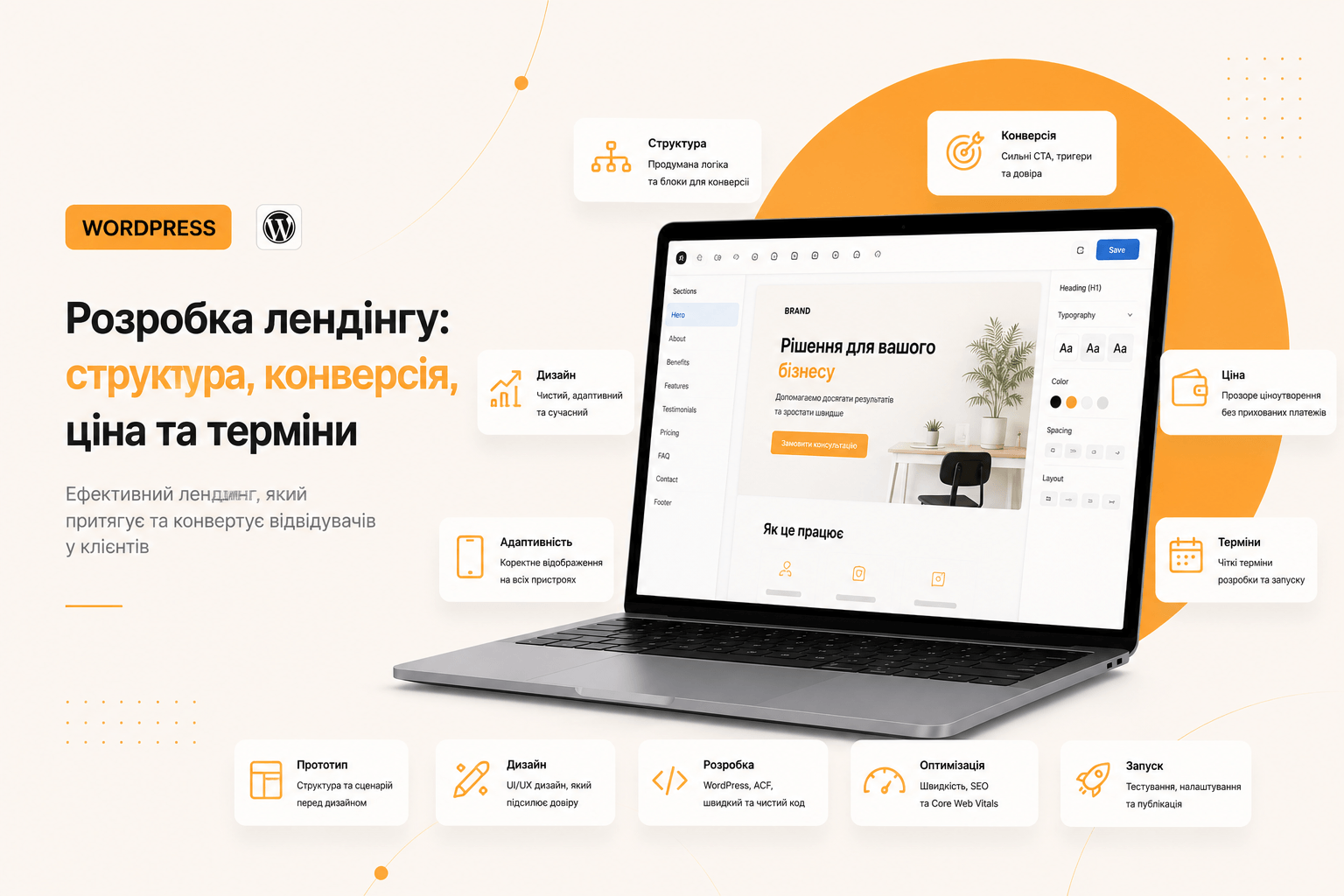
Stages of landing page development
- Brief and analysis. Product, audience, competitors, the main benefit.
- Prototype and copy. Block order and messaging — before any design appears.
- Design. Desktop and mobile versions, button and form states.
- Markup and development. Responsiveness, animations, forms, speed optimisation.
- Integrations and analytics. CRM, messengers, GA4, pixels.
- Testing and launch. Browsers, devices, end-to-end enquiry testing.
How much a landing page costs and how long it takes
The price comes down to three things: the number of blocks, the complexity of design and animations, the number of integrations. A landing page on a ready-made template with minimal edits and one with a unique design, copywriting and CRM are projects of very different effort, even though both are “one page”.
As for timelines, the typical range is from 1 to 3 weeks. What usually drags a project out is not development but waiting for content: texts, photos, access to ad accounts. If the materials are ready in advance, the timeline shortens noticeably.
Common mistakes
- Several different goals. “Request a call, subscribe and buy” — the user chooses nothing.
- A headline about the company rather than the client. “We have been on the market since 2011” converts no one.
- An eight-field form. Half the visitors will close it.
- Stock photos instead of real ones. Trust comes from real faces and real process.
- Launching ads without analytics. The budget is spent and there is no data.
- Nobody calls back. The best landing page will not save you if enquiries are handled the next day.
FAQ
How much does landing page development cost?
The cost depends on the number of blocks, design uniqueness, the need for copywriting and integrations with CRM and analytics. An exact figure comes after the brief: once the page structure and the list of integrations are clear, the estimate becomes predictable rather than a “market average”.
How long does development take?
Usually one to three weeks. One week if texts, photos and a clear structure are ready. Three weeks if a prototype, unique design, copywriting and integrations are needed. The main delay is not the code but waiting for content from the client.
Can a landing page be promoted in search?
To a limited extent. A single page can rank for a narrow group of queries, but serious organic traffic requires separate pages for separate topics and regular content. A landing page is tuned for paid traffic and direct visits; for search, a multi-page site with a blog is a better fit.
What conversion rate is considered normal?
There is no universal figure: it depends on the niche, product price and traffic quality. For mid-priced services, a typical benchmark is a few percent of visitors submitting an enquiry. Far more important than the absolute number is the cost per enquiry and how many of them become clients.
Can a landing page later be turned into a full site?
Yes, if it is built on WordPress with a custom theme. Service pages, a blog and a portfolio are added — the design and code stay the same. Moving a page out of a closed builder without a full rebuild is usually impossible.
Summary
A landing page is not “a one-page site” but a tool for a specific action. It works when three things come together: an honest offer, a structure that leads to the button, and a technical foundation — speed, a convenient form, configured analytics. Design matters, but it is this combination that brings in enquiries.
Tell me about your product and traffic source — I will propose a page structure, rough timelines and cost.