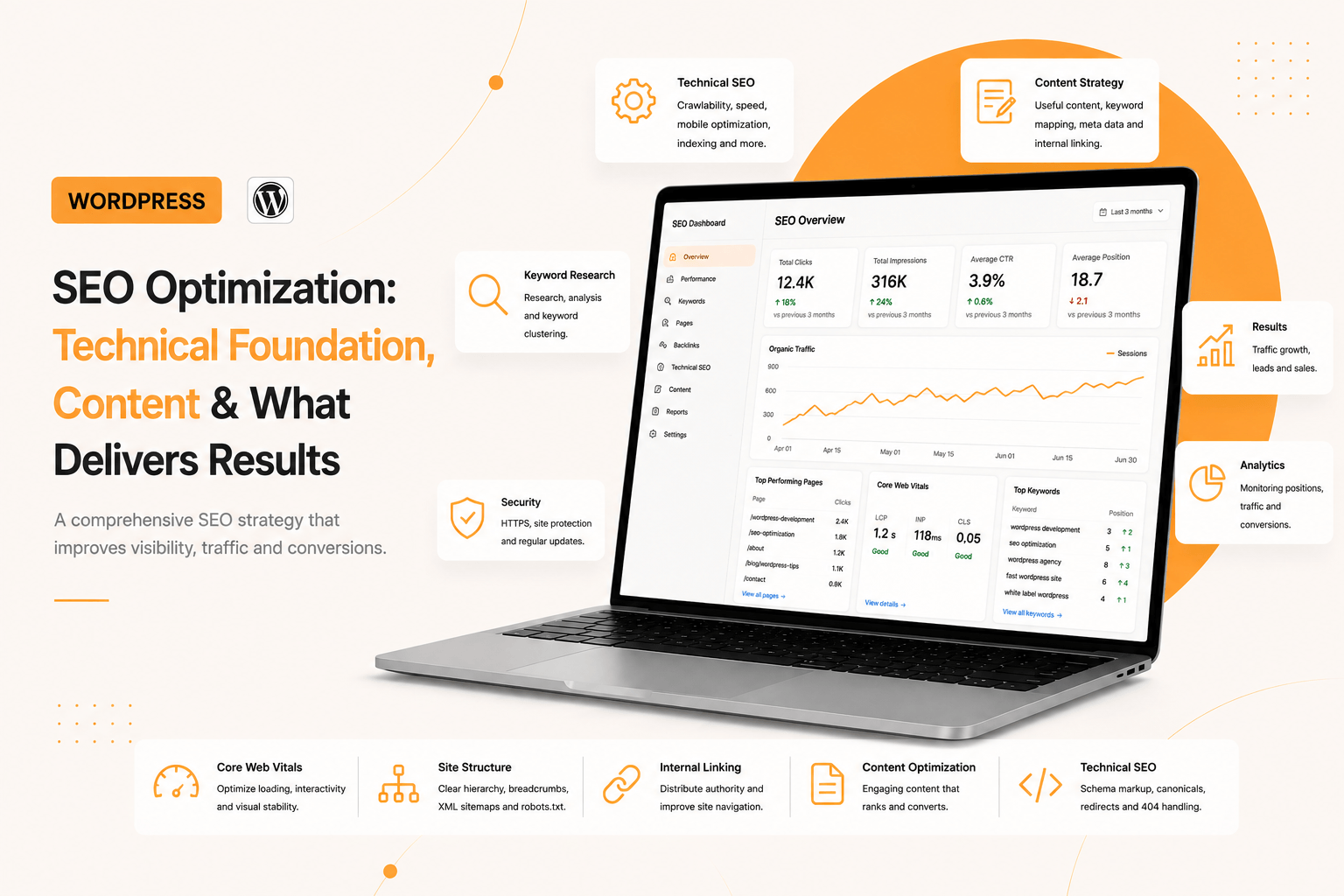
Website SEO optimisation is often sold as magic: “we will get you to the top in a month”. In reality it is engineering work in three parts — so the site can be indexed, so it answers the query better than competitors and so it is trusted. Everything else is implementation detail.
Let us break down what website SEO optimisation involves in practice, in what order to do it, which mistakes cost rankings and how soon results realistically appear.
What SEO consists of
It makes sense to split the work into four layers. Breaking the order is pointless: writing content for a site that indexes poorly is like pouring water into a leaky bucket.
- Technical SEO — accessibility, indexing, speed, structure.
- Keywords and structure — which queries the pages exist for in the first place.
- Content and on-page — how the page answers the query.
- External signals — links, mentions, reputation.
Technical SEO: the foundation
This is what the visitor does not see but the crawler does. Mistakes here cancel out any good content.
Indexing and accessibility
- robots.txt does not block the sections you need, and does block the service ones.
- The XML sitemap exists, updates and is submitted to Search Console.
- Canonical URLs are set — otherwise pagination and filters breed duplicates.
- A single domain variant with HTTPS, the rest via 301 redirects.
- No orphan pages that no internal link points to.
Speed and Core Web Vitals
Google evaluates real user experience. The key metrics: LCP (when the main element appeared, target under 2.5 s), INP (how quickly the page responds to input, under 200 ms), CLS (whether the layout jumps, under 0.1).
Speed is not a standalone “caching plugin” but the sum of decisions: WebP images with explicit dimensions, minimal third-party scripts, critical CSS, server-side caching. On WordPress the biggest gain usually comes from dropping heavy theme stacks and builders, rather than fine-tuning the cache.
Structured data
Schema.org structured data does not raise rankings directly but produces rich snippets: ratings, breadcrumbs, FAQ, author details. In the results this noticeably increases click-through. The minimum for a content site is Article, BreadcrumbList, Organization or Person, and for pages with questions — FAQPage.
Keyword research and site structure
The most common mistake is writing articles about “what I know” rather than “what people search for”. A keyword map is a list of real queries grouped by intent. One group of queries — one page.
Types of intent
- Informational — “how to choose a CRM”. A blog article answers it.
- Commercial — “website development price”. A service page answers it.
- Transactional — “buy a Lenovo laptop”. A product page or category answers it.
- Navigational — “Nova Poshta tracking”. A brand query.
Confusing intents is expensive: if you answer a commercial query with an article, the user goes to a competitor with a calculator and a button. If you answer an informational one with a sales page, they go where things are simply explained.
Search volume and competition
For a young site there is no point fighting for high-volume queries like “website” — those are held by resources with years of history. The entry point is mid- and low-volume queries, often qualified by region or task. They bring fewer impressions but a much warmer audience, and give the site its first rankings to grow from.
Content and on-page optimisation
Google has long assessed not keyword density but whether the page fully answers the query. But formal signals still matter — they explain to the crawler what the text is about.
- Title — up to 60 characters, keyword closer to the start, without repetitive spam.
- Description — up to 155 characters; it does not affect rankings but does affect clicks.
- One H1 per page, then a logical H2 → H3 hierarchy.
- URL short, in Latin characters, transliterated —
/seo-optymizatsiia-saitu/, not Cyrillic with percent-encoding. - Image alt text — a description, not a pile of keywords.
- Internal links with meaningful anchor text, not “here” and “read”.
E-E-A-T: experience, expertise, trust
Especially important for topics where the cost of a mistake is high: finance, health, law. In practice this means: a real named author with a bio, update dates, sources, contacts and company details. An anonymous text loses to the same text signed by a specialist.
Internal linking
The most underrated tool. Links from relevant articles pass weight to the target page and show Google the topical connections. A working scheme is clusters: one pillar page (e.g. full-cycle website development) and several articles around it, such as landing page structure, linking to it and to each other.
External signals
Links still work, but the rules have changed: a dozen mentions from live, topical resources do more than a thousand links from directories. Working sources: industry media, guest posts, partners, reference sites, service profiles, local directories.
For local business, a separate must is a Google Business profile with a correct address, category and reviews — it often brings calls faster than the site itself.
SEO for WordPress: what to consider
The CMS itself is SEO-neutral: implementation decides everything. The minimum set of decisions:
- One SEO plugin (Rank Math or Yoast) — not two at once, otherwise you get duplicate meta tags.
- Clean permalinks instead of
?p=123, with Cyrillic transliterated. - Block from indexing tag and date archives if they carry no value.
- A custom theme instead of a builder — less DOM, less CSS, better Core Web Vitals.
- Minimal plugins. Each one adds scripts and a risk of slowdown.
Order of work: where to start
- Technical audit. Indexing, redirects, duplicates, speed, mobile version.
- Fixing critical errors. First whatever blocks indexing.
- Keywords and structure. Query groups → a page map.
- Optimising existing pages. Title, H1, copy, internal links.
- New content to a plan. Regularly, for specific clusters.
- External mentions and analytics. Search Console, GA4, course correction.
Common mistakes
- Over-optimisation. Keywords in every sentence signal spam, not relevance.
- Duplicate pages from filters, pagination and parameterised URLs without canonical tags.
- Copied content — it does not rank and damages trust in the domain.
- Ignoring the mobile version, even though indexing has long been mobile-first.
- Buying links in bulk — a fast route to a penalty.
- A redesign without URL migration. Losing rankings overnight.
FAQ
How long does SEO take to deliver results?
The first changes in the results are visible after two to three months; stable traffic usually after six months and beyond. It is faster on a site with history that is technically sound: there it is enough to fix errors and add content. A new domain needs time for the search engine to build up trust.
Can first place in Google be guaranteed?
No, and any such guarantee is a marker of a dishonest contractor. The algorithm accounts for hundreds of factors, including competitors’ actions that you do not control. What can be guaranteed is the scope of work, transparent metrics and growth in visibility — not a specific position on a specific day.
Is installing an SEO plugin enough?
No. Rank Math or Yoast is a tool for filling in meta tags, the sitemap and structured data. It will not write content, build a structure around queries, speed up the site or earn mentions. The plugin saves time but delivers no rankings on its own.
Which matters more: technical SEO or content?
They are not competitors but a sequence. The technical base is needed so pages get into the index at all and open quickly. Content is needed so they answer the query better than competitors. A technically perfect site without content does not rank, just as a great article does not rank on a site that is not indexed.
Does site speed affect rankings?
Yes, Core Web Vitals are among the ranking signals, though not decisive ones. But speed has a wider impact: a slow site loses visitors before it loads, which worsens engagement metrics and conversion. Speed optimisation pays off even leaving SEO aside.
Summary
SEO is not a set of tricks but consistent work: remove technical barriers → understand what people search for → answer better than others → earn trust. The result compounds: unlike advertising, it does not disappear when you stop paying per click.
If you already have a site, start with a technical audit — it reveals the cheapest growth opportunities. I am happy to look at your project and say what will have the biggest effect first.